

Outdoor advertising, such as billboards and banners, are an integral part of today’s urban space. Their design and production is a complex process that requires many steps and specialized knowledge. In this article, we will present the production process of outdoor advertising step by step, from the idea to the final product.
Step 1: Define the goal of the ad
The first step in the production process of outdoor advertising is to define the goal of the ad. What do we want to achieve with this ad? Do we want to increase sales, increase brand awareness, or attract customers to a new product or service? Defining the goal of the ad is crucial, as it will affect the entire production process.
Step 2: Choose a location
The next step is to choose the right location for the ad. The choice of where to place the ad can have a big impact on its effectiveness. Depending on the goal of the ad, you need to choose a location that will allow it to reach the target audience effectively. For example, if we want to increase product sales, we need to choose a location where the ad will be visible to people who are interested in that product.
Step 3: Design the ad
The next step is to design the ad. Graphic designers create a design for the ad that will meet the goal of the ad, be attractive to the audience, and be in line with marketing principles. The design should contain the appropriate amount of text, graphics, and color. It is also important that the design is readable and easy to understand.
Step 4: Choose materials and production technology
After the design is approved, the next step is to choose the materials and production technology. Depending on the type of ad and its purpose, you need to choose the right materials and production technology. For example, billboards use special materials that are resistant to weather conditions, and printing is done using large format technology.
Step 5: Print the ad
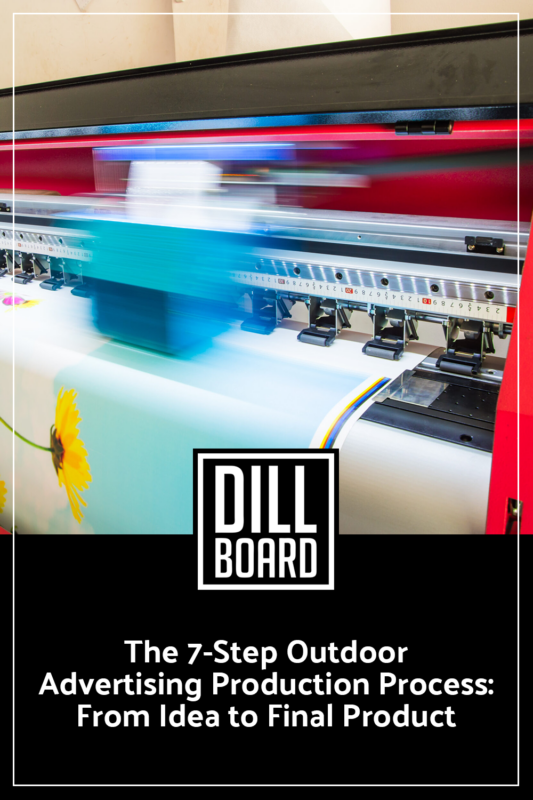
After the file is approved by the client, the production process moves to printing. Printing is one of the most important steps in the production of outdoor advertising, as the quality of the print has a direct impact on the appearance and durability of the final product.
There are many printing techniques that can be used in the production of outdoor advertising, including digital printing, eco-solvent printing, UV printing, sublimation printing, and many others. Each of these techniques has its own advantages and disadvantages, and the choice of a specific technique depends on many factors, such as the size of the print run, the type of carrier, quality requirements, and delivery time.
Digital printing is a popular choice due to its flexibility and ability to print on a variety of media. Eco-solvent printing is commonly used for printing on self-adhesive films, while UV printing allows for durable and waterproof prints. Sublimation printing is often used for printing on fabrics.
Each printing technique has its own special requirements, and preparing a file for printing can be time-consuming and effort-intensive. Therefore, it is important to hire specialists with experience in printing outdoor advertising, who will help in preparing the file and select the appropriate printing technique.
Step 6: Processing and finishing
After the printing process is complete, the ad goes through the processing and finishing process. This phase includes cutting, lamination, cutting, sewing, and many other processes that are intended to bring the ad to its final form and make it ready for installation.
Cutting is the process of removing unnecessary elements from the print. Cutting can be done manually or using cutting machines. Lamination is the process of applying a clear film to the surface of the ad to increase its durability and protect it from external factors such as moisture, UV rays, and wind. Cutting is the process of trimming the ad to the desired size, and sewing is the process of joining two or more pieces of material into a single, coherent element.
All of these processes require precision and skill to achieve a final product of high quality and durability. Therefore, it is important to hire experienced specialists.
Step 7: Installation
The final step is to install the ad in the chosen location. This is usually outsourced to an external company that has experience and specialized equipment for installation. It is important that the ad is installed on a stable surface and in accordance with safety requirements.
It is worth remembering:
Outdoor ads are exposed to the elements and can be damaged. Therefore, it is important to regularly maintain them and keep them in good condition. Maintenance includes cleaning, technical inspection, and replacement of damaged parts.
When the ad is no longer needed or has expired, it must be removed. Dismantling and removal of outdoor ads also requires specialized equipment and skills to avoid surface damage and safety hazards.
The entire process of producing outdoor ads is carried out in accordance with the customer’s requirements and according to specified industry standards. A well-made ad can be an effective marketing tool, attracting the attention of potential customers and building the company’s image.