

Billboards and large format ads are one of the most effective ways to promote your brand or product. In just a few seconds, you can capture the attention of potential customers and convey important information to them. However, designing effective billboards and large format ads requires some knowledge and skill. In this article, we will discuss several important factors to consider when designing these materials.
1. Find the right place for your ad
The location of a billboard or large format ad is crucial to its effectiveness. You need to find the right location that will provide the most exposure for your ad. Here are a few tips to help you choose the perfect location:
- Find places with high traffic, such as highways, main roads, or public squares.
- Consider visibility. Make sure your ad is visible from a distance and stands out from the surrounding environment.
- Find a place where the ad will have the biggest impact on your target audience. For example, if you are promoting a product for young people, find a place where young people gather.
2. Focus on the message
Billboards and large format ads need to have a short and concise message that quickly grabs attention. The text on your ad should be easy to read, and the graphics should be eye-catching and relevant to your brand or product. Here are a few tips to help you focus on the message:
- Use powerful headlines. The headline should convey the most important information.
- Use graphics that are easy to read and have a strong connection to your brand or product.
- Keep the message simple and understandable for everyone.
3. 3. Choose the right colors
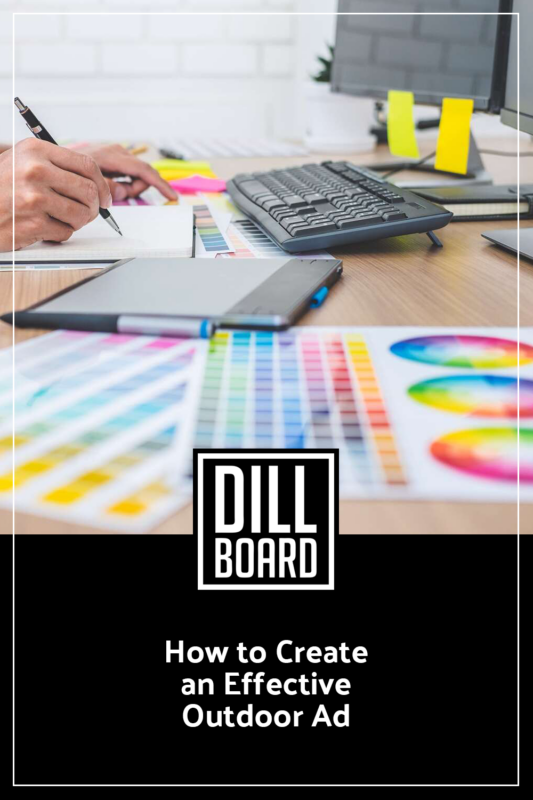
Colors are a key element in the design of billboards and large format ads. The right choice of colors can grab attention, reinforce the message, and increase the effectiveness of the ad. Here are a few tips for choosing colors for a large format ad:
- Use colors that are associated with your brand. The colors of your brand should be incorporated into the design of the billboard or ad, as they help to build brand awareness and recognition.
- Use contrast. Well-chosen colors with high contrast, such as black and white or red and yellow, can grab attention and increase the readability of text.
- Be careful with too bright or too dark colors. Too bright colors can be tiring on the eyes, and too dark colors can make text difficult to read.
- Choose colors that are consistent with the context. If the ad is to be displayed in a specific environment, such as against a background of green or blue sky, choose colors that will blend in well.
- Limit the number of colors. Too many colors can make the ad look chaotic and difficult to read. It is generally recommended to use a maximum of three colors in one ad.
Remember that the choice of colors depends on many factors, such as the brand, message, campaign goal, and environment in which the ad will be displayed. If you are unsure what colors to choose, it is worth seeking the advice of experts or conducting market research to learn about the color preferences of your target audience.
4. Pay attention to contrast and readability
A good ad should have a clear contrast between the text, graphics, and background. Contrast allows for better visibility, which attracts the attention of potential customers. Choose colorful graphics that stand out from the background and make it easier to read the text. The text on the billboard should be legible and easy to read from a distance. Choose fonts that are simple and easy to read, even from a distance.
5. Take care of the location
The location of a billboard is of great importance. Choose a place where it will be visible to your target audience. Choose a place with a lot of traffic, such as a road or intersection. Choose a location near your business or the place you want to promote.
6. Don’t overdo it with information
Billboards should only contain the most important information, such as the name of the company, logo, short description, and contact information. Don’t overdo it with the amount of information, as it can make the ad difficult to read. Use the space on the billboard to present one or two key points and encourage potential customers to take action.
Summary
Summary Designing billboards and large format ads requires taking into account many factors, such as location, content, and color scheme. A good ad should grab attention, be easy to read, and contain only the most important information. Preparing an effective ad takes time and effort, but it can bring great benefits to your business.
We hope this article has helped you better understand how to design effective billboards and large format ads. Remember that designing good ads requires continuous improvement and testing. Don’t be afraid to experiment and look for new ideas that will help you stand out from the competition.